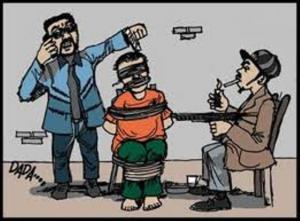
 Many people from my home town, Ibusa in Delta State of Nigeria decried the manner at which people were being kidnapped by unknown men. We are demanding answers to some pertinent questions that spurred on this article: WHO IS NEXT? WHAT MEASURES ARE WE TAKING TO SECURE IBUSA AND IT’S ENVIRONMENT AGAINST THE SPATE OF KIDNAPPING? There cannot be a better time to seek answers to these questions than now. Kidnapping is pervasive and becoming a global phenomenon. It allows perpetrators to put individuals or the entire community at an alarm mode by real or imagined fear of abduction using violent or terrorizing means. Kidnapping infringes upon our cultural values and impacts negatively on the genial nature of being our brother’s keeper. The rampancy of it is already having telling effect on trust and social life of Ibusa people. We are now suspicious of one another in view of allegation that most of the kidnappings are carried by non-Ibusa indigenes with active collaboration of victims’ neighbours and relatives. It takes away the sense of peace, security and feeling at home that we all enjoy when visiting home for burial of love ones or to celebrate festive seasons, such as Christmas, New Year, Easter, New yam and many other festivals.
It is not difficult to envision the feeling of despair and sense of hopelessness the menace of kidnapping has visited upon Ibusa people both at home and in diaspora. The situation therefore demands urgent action as it continues to garner many converts by the day and could be anybody next. The situation has obvious implications for future investments, Ibusa’s development trajectory and even peaceful co-existence of indigenes and non-indigenes if not arrested. Without sounding too pessimistic or cynical, solution to the menace of kidnapping would be difficult to find given the current climate of impunity in Nigeria. Thus, this article would explore some suggestions made as preventive measures to minimise your vulnerability to kidnapping in Ibusa or elsewhere.
In a rejoinder to a Newspaper editorial on kidnapping menace, Ausaf Husain, a retired Squadron Leader and security expert based in Karachi proposed some preventive measures against kidnapping. He argued that following his suggestions will complicate kidnappers’ planning to such an extent that they would most likely look elsewhere for their victim. Perhaps, it will be a good idea to first consider some measures taken by our governments to curb the menacing situation before sharing his suggestions with you.
Many States in Nigeria such as Abia, Akwa-Ibom, Anambra, Ebonyi, Enugu and Imo have enacted new Laws to deal with kidnapping. In Ebonyi State, for instance, there is the Internal Security and Related Matters Law 2009; Imo State Prohibition of Hostage Taking and Other Related Offences Law No. 4 of 2009; and Zamfara State sections 229 – 233 of the Shari’ah Penal Code Law 2000. Many of these states have made kidnapping a capital offence and many more are in the process of enacting similar laws that will introduce capital punishment for kidnapping in their respective States. One traditional ruler even took a more desperate step to curb the menace of kidnapping in his kingdom. It was reported recently that the Oba of Benin directed his chiefs and traditional worshippers to invoke curses on the perpetrators of kidnapping and other crimes in Edo State. Unfortunately these measures have not succeeded in arresting the situation. Capital punishment in particular has been notably ineffective in curbing crime. In 1970s, for instance, Federal Government of Nigeria introduced death penalty for the offence of armed robbery. It is on record that the capital punishment did not stop the spate of armed robbery. It is also on record that armed robbery became more pervasive and armed robbers became better organised with more sophisticated weapons, more determined and vicious.
On international level, kidnapping is pervasive especially in some countries in Africa, South America, Eastern Europe and Asia. One thing is common in these countries where death penalty was introduced as punishment for kidnapping; such measure has proved unsuccessful. For example, Priyanka Bhardwaj writing in Siliconeer, a Monthly Magazine in West Coast U.S.A. for South Asians posited that since 1992, over 2,200 abduction cases have been registered in the Indian capital, Delhi. Despite kidnappers facing death penalty, nearly 5,000 kidnapping incidents happen every year in the whole of India. Kidnapping for ransom is a social menace and effective solution can only evolve from addressing the root causes of the problem. No matter the harshness of the retribution for the offence, if the underpining causes are not eradicated, kidnapping and indeed most crimes would persevere. So, what are the main root causes?
The menace of kidnapping in Ibusa and other places where it is pervasive is occasioned mainly by political and socio-economic factors. Political factors relate directly to the breaking down of law and order and the failed policies of Nigerian governments at all levels (local, state and federal). The factors also relate to deep rooted culture of impunity which is one of the major symptoms of failed or failing states. Similar political factors could be found in failed states such as Afghanistan and Iraq after the invasion of 2001 and 2003 respectively; or failing states such as Columbia from the 1970s until about 2002 and Mexico between 2002 and 2007. However, there is exception to this view. For example, kidnapping for ransom in countries such as India and Brazil is mainly the result of socio-economic factors. These are emerging economic giants with mix of acute social and economic disparities between the very poor and the very rich. One of the negative consequences of the widening gap between mostly young successful entrepreneurs flaunting their wealth and the jobless youths and the downtrodden is kidnapping for ransom. However, one common socio-economic factor in countries where kidnapping is pervasive relates to lack of employment opportunities. Ibusa for instance, even as part of the State’s capital territory, cannot vaunt for any major employer both in private and public sector. Empirical studies have shown that high youth unemployment exacerbates crime. In other words, creation of employment opportunities would decrease the incidence of kidnapping as those who are engaged in it would become gainfully employed. It is most likely that youth joblessness is directly related to the general increase in criminality in Ibusa. The introductions of unemployment’s benefits have also been known to reduce crime as evident in the recent amnesty programme introduced by Federal government for the Niger-Delta militants. Other socio-economic factors include limited educational opportunities, the lack of the enabling environment and weak infrastructures. To date, Ibusa lacks basic infrastructure such as good roads, electricity and water supply. There is very limited secondary schools and no single tertiary institution in the town. The gap between few rich politicians and bureaucrats and ordinary citizens is widening in an atmosphere of youth uncertainty and hopelessness about the future.
It seems like a hopeless situation since it is the responsibility of the Government to provide security, eradicate deplorable conditions of poverty, diseases, unemployment, and deal with lack of the enabling environment and weak infrastructures that encourage kidnapping and other crimes that pose a threat to peace and development in the town. Governments of all levels have let Ibusa people down in view of their inability to create employment opportunities, welfare and social amenities for the benefit of our deserving youths. The State and the Local Governments have failed to have a clear strategy on crime prevention in the town. However, any successful crime prevention strategy will depend on the prospect of offenders being caught, detained, promptly prosecuted, convicted and sentenced. Successful prosecution on the other hand would depend on investment in local police intelligence gathering and arresting offenders; investigating offences committed and prosecuting offenders while respecting their fundamental human rights. The courts should have the freedom to guarantee fair and speedy trail of cases and ensure that punishments truly reflect the crime. Experts believe that any compromise in any part of this chain would impede any attempt at preventing crime. The chain is in no doubt compromised in many parts, if not all, by the culture of impunity in all spheres of Nigerian political life. The provision of security is a primary purpose of governments at all levels. Thus, the failure to stop the scourge of kidnapping which started in 2006 by Niger Delta Militants is certainly a manifestation of a failing government at all levels. The question, therefore, is what can we do as individuals to forestall the bane and nightmare of kidnapping in Ibusa?
In Ausaf’s view, kidnappers and other criminals, while targeting their potential victim, have been known to evaluate their chances of success based on the following vulnerabilities:
Media value: prominent individual in the community or corporate name recognition, product or service identification and ones standing in business, government, the entertainment industry or social circles; all add up to ones value as a potential target for kidnapping.
Apparent wealth of their potential victim: This evaluation is particular important to the kidnappers. This is because the gain for kidnapping depends on apparent ability of the potential victim or his family to pay ransom. This probably explains why spouses, parents and children of wealthy individuals are often the targeted victims of kidnapping. In other words, it is your perceived wealth that makes you vulnerable and a prime target for kidnappers. Ausaf’s suggestion is that you and your family should keep a low profile.
Accessibility to potential victim: the paradigm of the path of least resistance applies. A ‘hard’ or protected target is less likely to be a victim than a ‘soft’ or vulnerable target. In addition, professional kidnappers apply the principle of risk reduction in the selection of target. Their objective according to Ausaf is to reduce the risk of failure. Given a chance, they will focus their efforts on a target that offers the best chance of success. These are mainly potential victims whose personal security habits are lax and whose patterns of activities are predictable. He suggested that you should avoid potentially dangerous situations. He added that recognising a potentially dangerous situation without taking steps to avoid involvement is foolhardy.
Ausaf included security advice for those of you travelling home this festive session.
i. You should make a detailed vulnerability assessment and familiarise your family members with the assessment made if they are travelling with you.
ii. You should talk candidly about safety concerns with your family, especially as spouses and children besides being targeted could carelessly disclose information regarding your activities, which could make you or any of them prime target for kidnappers.
Ausaf also advised on what to do when you fell victim of kidnapping. He suggested that
i. you must respond properly if confronted by kidnappers. He contended that appropriate response to a threat of kidnapping covers a broad spectrum from passive compliance to disabling the kidnapers and escaping.
Finally, adopt and follow all principles of good security.
ii. Use common sense;
iii. keep yourself well-informed about the day-to-day criminal activities in the area you live or are visiting.
iv. exercise prudent judgment; and conduct your personal vulnerability assessment when necessary.
v. Increase your awareness by learning more about the nature and scope of the threats that exist in the area you live and learn from the experience of others.
vi. Read the accounts of kidnapping and other criminal activities in the area you are visiting in newspapers or relevant media and take necessary precautions to remain safe.
 vicheku